|
|
|
The are no messages in your guestbook.
|
|
|
About 16th Century Visual Artists
|
There are a number of mid-16th century portrait medals of Pope Paul III exhibiting a similar obverse with minor variations and a reverse that is completely different. The Pope Paul III, Griffin reverse bronze medal gilded in gold created by Michelangelo was made while Pope Paul was living, however other medals of Pope Paul may be posthumous. Adding to the challenge of dating medals of him is that his age and appearance vary markedly within several years. This can be due to artistic license, less talented artists not portraying him accurately and poor production of a medal with reduced detail which are all significant factors as well as Pope Paul's rapid ageing especially since he was elderly and under stress.
The following prominent artists/sculptors/medalists were working during the mid-16th century, some of whom were in Rome. What stands out in reviewing their art is that their work looks nothing like the Michelangelo medal, so none of these artists other than Michelangelo could have created it. The same applies to an artist that is cited as unidentified or unknown, whether a medal is gilt or not, it is an inferior later copy. Michelangelo is the creator of the original. Pope Paul III/Griffin reverse medals being cited as having been made by a specific artist other than Michelangelo are misidentified unless as a later casting with the artist copying it from an existing mold that had been created by Michelangelo or from a medal that was cast later. There is also the possibility that a bronze medal cast by Michelangelo but rejected by him in favor of the bronze medal that he chose to gild was used as the piece for subsequent copies or re-casting. Michelangelo could also have taken an impression of his bronze medal before gilding it and that impression was later used for copies. Various processes could have been employed.
Michelangelo Buonarroti - The Pope Paul III obverse and Griffin reverse gilt bronze medal looks like Michelangelo's art. The superiority of this medal is light years beyond any other medal created during this period. The high caliber is reflected in its masterful handling of formal elements, exceptional technical execution and monumentality. There are no weak areas within the medal, obverse or reverse, that are typically present in art by less talented artists. Michelangelo utilized the lost wax method or technique allowing for extremely fine detail and precision and enhanced by exceptional chasing and finishing of the gilded gold.
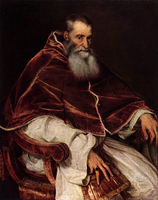
Titian - A brilliant artist and one of the greatest portrait painters of the day. Pope Paul required the greatest artists create his portraits, and this is why he had Titian paint his portrait and Michelangelo sculpt his Pope Paul III/Griffin reverse gilt bronze medal.
An Unknown Artist - This is included because what is the possibility that an unknown artist emerges from nowhere at a specific time to create the greatest medal of the era and then disappears never to create another medal anything like it again all while having access to the pope and at a time when artists were celebrated. The possibility of this occurring is zero. No Possibility. The same goes for far less talented artists of which there were many when compared to Michelangelo. The medal created by Michelangelo required tremendous artistic ability and knowledge.
Alessandro Cesati - One of the medals attributed to him has an obverse of Pope Paul III and a reverse of Ganymede. The medals were produced as restrikes and while a year on the medal indicates that Pope Paul III was living, even the earlier mid-16th century medals are likely commemorative and were actually produced after his death in November 1549. A nude male youth on the reverse of a papal medal is rather curious and while the obverse is a tribute to Pope Paul III the reverse may be a tribute to Michelangelo as his love of the beauty of youth and the male nude was known.
Leone Leoni 1509-1590
Benvenuto Cellini 1500-1571
Valerio Belli 1468-1546
Bombarda (active) 1540-1575
Guglielmo Della Porta c. 1500-1577
Alessandro Vittoria 1525-1608
Francesco da Sangallo 1494-1576
Jacopo Nizzola da Trezzo 1515 or 1519-1589
Giovanni Bernardi 1494-1553
Antonio Abondio 1538-1591
Domenico di Polo de Vetri 1480-1547
Gianpaolo Poggini c. 1518-1592
Domenico Poggini 1520-1590
Pier Paolo Galeotti c.1520-1584
Alfonso Ruspagiari 1521-1576
Matteo Pagano called Mateo della Fede (active) 1543-1562
Giovanni da Cavino 1500-1570
Andrea Spinelli 1508-1572
Maffeo Olivieri 1484-1543/1544
Giovan Federico Bonzagni 1507-1588
Pastorino de' Pastorini c.1508-1592
AM
| Contact Me: |
Everyone can contact me |
|
16th Century Visual Artists' Friends
|
|
|